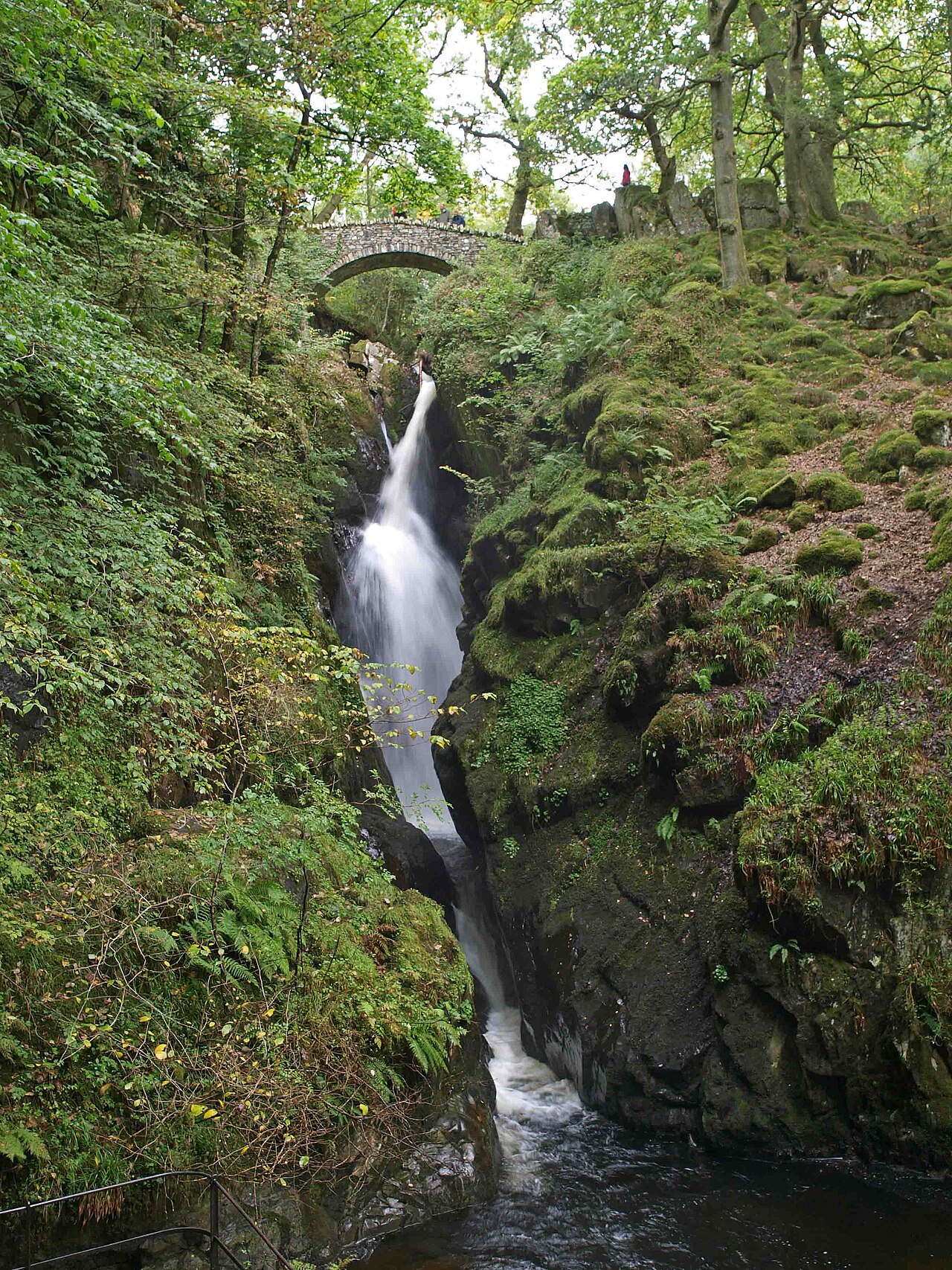

Two landscapes, two reasons to walk
Aira Force concentrates attention on water, woodland and a confined gorge. Gowbarrow opens that experience into an upland walk with views across Ullswater. Combining them gives the day a clear contrast, but the longer circuit should not inherit the assumptions attached to a short waterfall visit. The National Trust presents several routes in this landscape rather than one path with optional length added indefinitely.
Begin with the reason for the outing. If the waterfall and trees are the principal interest, select a defined woodland route and spend time there. If you want a fell walk that includes the gorge as its opening, the Gowbarrow circuit is the relevant plan. This avoids the common situation in which a party reaches the waterfall, sees a sign for a summit and assumes that it is simply another nearby viewpoint. A destination can share the same starting area while requiring a different commitment.
The gorge is not an obstacle-free approach
The main waterfall landscape contains steps, narrowing paths and slopes beside the gorge. Its developed viewpoints make the water visible from established paths, but development does not make the whole area flat. The National Trust’s access information distinguishes the lower glade and other easier areas from the fuller waterfall routes. Choose the specific line that fits the group rather than treating the name Aira Force as a single accessibility description.
For a Gowbarrow day, this first section is part of the walking rather than a free prelude. Stops at the water, bridges and trees take time, and the steps contribute to the effort before the main fell ascent begins. That is not a reason to hurry through them. It is a reason to allocate the outing honestly. If the gorge has already supplied enough walking, a defined return within the selected woodland route can complete the visit without diminishing it.
The point where the day becomes a fell walk
The official Gowbarrow circuit continues beyond the waterfall area, follows the upper woodland corridor and then emerges onto open ground. This is the important transition in the route. Enclosure by trees gives way to a broader slope, a more open outlook and a different sense of distance. The summit is reached through its own uphill section rather than by merely following the water to another bridge.
Use that change of environment in your route notes. A concise sequence is gorge, upper woodland, open ascent, summit and flanking return. It is more informative than writing Aira Force circular walk, because it identifies what the longer version contains. The National Trust lists the full route at roughly 7.2 kilometres. That measurement belongs to the whole Gowbarrow circuit, not to a visit to the principal waterfall viewpoint. Do not use the shortest waterfall distance to describe the larger day.
The return is part of the reward
After the summit, the circuit continues around the fell rather than simply reversing every step of the ascent. The relationship with Ullswater becomes central: the lake is viewed as part of a wide landscape, contrasting with the close-up movement of water in the gorge. This is the reason to choose the full circuit. It adds a genuinely different experience rather than more of the same woodland.
The lower return eventually reconnects with the Aira Force area, but the summit should not be treated as the end of the route. The eastern-flank walking remains part of the plan. A party that wants only a brief elevated glance may be better served by a shorter, clearly defined alternative than by starting a circuit whose principal variety comes after the high point. Read the full shape before committing, so the return feels like the planned second half rather than an unexpectedly long way back.
Make the alternatives explicit
There are three sensible levels of ambition here: a lower woodland visit, a fuller waterfall route and the open-fell Gowbarrow circuit. They answer different needs. The first focuses on the immediate setting; the second explores the gorge more thoroughly; the third adds a summit and a lake panorama. A route comparison should explain those differences instead of implying that every visitor ought to progress to the longest option.
For a mixed group, select the common objective in advance. Do not rely on a vague promise to decide later when the party may already be separated between bridge levels or path junctions. A shared waterfall goal can be satisfying, and a separately planned full fell day can be equally satisfying. The strongest Aira Force plan is the one whose terrain and duration match the chosen landscape experience, with any operating or access questions checked through the land manager rather than inferred from an attractive photograph.
Questions answered
Does the full circuit stay in woodland?
No. The Gowbarrow route leaves the wooded gorge and climbs onto open fell before completing a flanking return. That transition is the main difference from a shorter waterfall visit.
Can the waterfall itself be the main goal?
Yes. A defined gorge route is a complete visit. Add Gowbarrow only when its ascent, open terrain and full return are part of the intended day.
Sources & scope
Route facts are drawn from the resources below. The comparisons and recommendations are our research-based editorial analysis; this is not a claim of personal trail inspection. Access and conditions must be checked with the responsible land manager before travel.
- National Trust: Aira Force and Gowbarrow circuit
- National Trust: visiting Aira Force and Ullswater
- National Trust: Aira Force access information
Editorial standards · Explore the destination guides
Found a detail that needs correcting? Send the guide URL and a supporting source so we can review the exact route version.