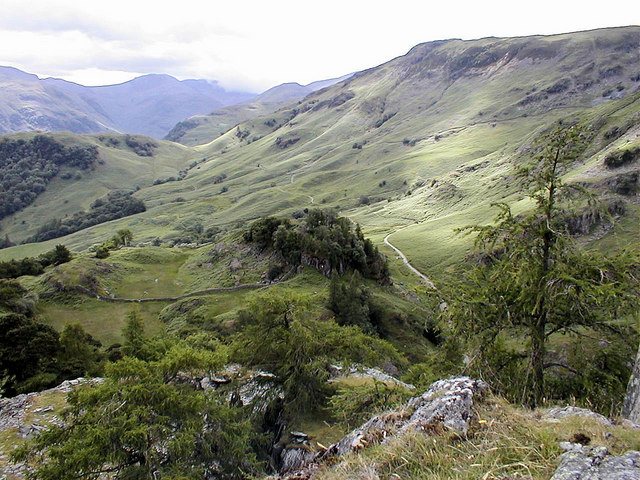

The small fell in the narrow valley
Castle Crag occupies a striking position within Borrowdale’s narrowed landscape. The enclosing slopes and river make the fell feel substantial even though its summit is low compared with the high central mountains. This is why it works as a specific walking goal rather than merely a minor peak on a list. The viewpoint helps explain the transition between Derwentwater and the upper valley.
That setting also explains why the height should not be used as a difficulty score. A low summit can have steep flanks, rough approaches and a rocky finish. The National Trust offers several ways of exploring this part of Borrowdale, including a Seatoller circuit and a geology-oriented route from the Bowder Stone area. These are different journeys sharing a focal point. Choose the approach that suits your desired valley experience before deciding that Castle Crag is the obvious easy option.
Seatoller creates a contour-and-river circuit
The National Trust’s Seatoller route begins with an ascent, follows the valley side toward Castle Crag, then returns using lower riverside connections. Its published complete circuit is about eight kilometres. The shape matters more than the impression that the summit is close to the valley road: the outing includes a substantial journey around the surrounding landscape rather than a direct climb from beside the fell.
The advantage is variety. The outward route presents Borrowdale from the side, while the return gives a more enclosed river perspective. The cost is that the group must be happy with the complete combination of surfaces. A route can be broadly moderate yet contain individual sections that decide whether it is suitable for someone avoiding rough ground. Read the terrain description before assuming that a riverside return will be the smooth part of the day.
Published time belongs to the complete Seatoller loop
The National Trust lists its approximately eight-kilometre Seatoller circuit at three to four hours and fifteen minutes. That is an indicative range for the whole contour, summit and river outing, rather than time to Castle Crag alone. The Rosthwaite connection creates another version and should be measured as such. Treat the return’s separate rocky interruption as part of the decision even when the quarry summit is the feature that first attracted the group.
Rosthwaite is a different starting decision
Rosthwaite sits within the valley and offers another logical place to begin a Castle Crag outing. The Trust describes how its village connection can join the larger route. If you use it, draw that connection and the intended return as a complete route rather than retaining the Seatoller mileage by habit. Moving the start does not merely change where the car is left; it changes which lower paths are repeated and when the valley is crossed.
Choose Rosthwaite when your accommodation or desired valley walking is centred there. Choose Seatoller when the longer contour-and-river circuit is itself the attraction. Neither choice is improved by switching between different published starts midway through your notes. Keep the actual start, route junction and finish together. That makes it possible to compare a summit outing with the lower valley walk honestly, without making either one artificially short.
Quarry ground is part of the summit character
The final approach is associated with historic slate quarrying and loose stone. The summit experience is therefore not simply the last few metres of a grassy hill. Stone fragments, a zigzagging line and uneven footing belong to its character. The National Trust also identifies a separate short rocky interruption on the Seatoller circuit’s riverside return. These are distinct issues: avoiding one by choosing another approach does not prove every part of the resulting day is smooth.
There is no need to publish techniques for negotiating difficult rock to make this information useful. The planning decision comes earlier: does the group want a route containing these features? If the answer is no, a lower Borrowdale objective is more appropriate than treating the summit as compulsory. If the answer is yes, the quarry landscape gives historical context to the walk. Its industrial traces are part of the place, not obstacles to ignore while concentrating only on the summit view.
Choose the valley if the valley is what interests you
Borrowdale’s lower paths can provide a complete outing beside the River Derwent and through the landscape around Rosthwaite and Grange. The National Trust explicitly identifies a low-level river alternative in its valley overview. This is useful for a party whose main interest is woodland, fields and the constricted valley, rather than climbing Castle Crag itself.
Do not describe the lower alternative as the summit route without the hard bit. It has a different purpose and deserves its own clear start and turnaround. A summit day gives an elevated reading of the valley and the quarry finish; a river day gives close attention to water, woodland and settlement. The better choice is the one that matches the reason for visiting Borrowdale. You can have a distinctive day here without using summit height or completion as the only measure of success.
Castle Crag also makes sense as a historical landscape, with the summit memorial and quarry traces giving the high point a meaning beyond its height. Appreciate those features from the established walking line rather than treating the abandoned industrial ground as an invitation to explore unstable-looking side routes.
Questions answered
Is the eight-kilometre figure a direct climb from Rosthwaite?
No. It describes the National Trust’s complete Seatoller circuit. A Rosthwaite start needs its own mapped connections and total.
Can I avoid the summit and still have a worthwhile Borrowdale walk?
Yes. The lower river landscape around Rosthwaite and Grange is a coherent objective. Choose and measure that route directly instead of treating it as an unfinished ascent.
Sources & scope
Route facts are drawn from the resources below. The comparisons and recommendations are our research-based editorial analysis; this is not a claim of personal trail inspection. Access and conditions must be checked with the responsible land manager before travel.
- National Trust: Castle Crag from Seatoller
- National Trust: exploring Borrowdale
- National Trust: Borrowdale geology walk
Editorial standards · Explore the destination guides
Found a detail that needs correcting? Send the guide URL and a supporting source so we can review the exact route version.