
Choose the circuit before collecting route names
Grasmere village, Grasmere lake and Rydal Water sit close enough to form a satisfying walking landscape, but several distinct routes use those names. A circuit from the village can take in both lakes and return to its start. The national park’s Grasmere Trail instead links Grasmere with Ambleside as a one-way journey. The Coffin Route uses higher ground on the valley’s northern side. Each is coherent on its own; they should not be combined casually under one headline distance.
For this outing, make Grasmere village the start and finish and the two waters the main interest. The National Trust identifies a two-lake circuit of roughly eight-and-a-half kilometres. Use the manager’s mapped line as the definition of that version rather than trying to add together every shore path visible in different guides. A clear loop prevents the day from quietly expanding into a summit outing or a longer walk all the way to Ambleside.
Understand the landscape between the waters
The connection around White Moss is not simply an urban pavement between two lake entrances. Woodland, paths, river crossings and changes of level give the link its own character. This is where a two-lake day gains variety: water that has been viewed as a broad surface becomes a narrower river corridor before another shore opens ahead. The change is part of the route’s appeal, not wasted distance between scenic stops.
It also means that low-level does not mean completely flat. The park’s descriptions of routes around White Moss and Rydal Water mention slopes and mixed ground. If the group’s main requirement is a particular surface, examine the exact connecting path rather than assuming every path near the water is equivalent. A short, selected Rydal shore visit can be a better fit than a complete two-lake circuit for somebody seeking a more constrained outing.
Which side of the valley gives the day its character?
The area offers a choice between closer water-level views and paths that sit somewhat higher on the slopes. A higher line can reveal the shape of the lakes, while a lower path gives the immediate experience of shoreline, trees and reflections. This is a meaningful scenic decision, but it must remain inside a fully mapped route. The word terrace does not mean that every connection to it is level.
For a first two-lake outing, resist using Loughrigg summit as an automatic extra. The fell is a separate high objective with its own ascent and return choices. A two-lake circuit already gives a complete landscape sequence. Adding the summit can shift attention from the water and woodland to completing an ambitious list. Choose the high day when that is the experience you want, and allow the low circuit to be a different day rather than an inferior version of it.
Choose the shore day or the historic connection
Choose the two-lake circuit for water-level foregrounds, woodland and a self-contained return to Grasmere. Choose the Coffin Route when the desired experience is the older village-to-village connection through Town End and the lower Nab Scar slopes toward Rydal Mount. The first is a lake-and-woodland day; the second is a historic slope-side journey whose return is a separate choice. They overlap geographically but should not serve as two differently named versions of one undifferentiated itinerary.
For a first Grasmere weekend, pair the two-lake circuit with Helm Crag if a steep fell day is wanted. If cultural landscape is the priority, choose the Coffin Route instead of the fell, leaving the full lake circuit as the contrasting water-focused day. This is a stronger use of two outings than adding every attractive line to one large circuit and repeating the same ground the following morning.
The village connection is real walking
Starting in Grasmere brings streets and lanes into the beginning and end of the route. They should be included in the distance, just as the woodland links should. The lake is not identical with the village centre, and a guide beginning at a shore access point may omit a connection your day requires. This is particularly easy to overlook when the same word appears in both the start name and the lake name.
Choose a start that is practical for your actual stay and draw the entire return. If you finish at a different village or continue toward Ambleside, you have selected a linear outing instead. That can be worthwhile, but the return journey must then be arranged independently. The strongest reason to choose a circuit is its complete shape: you can enjoy two distinct waters and the connecting landscape without needing another transport leg to make the day whole.
How to make the two lakes feel different
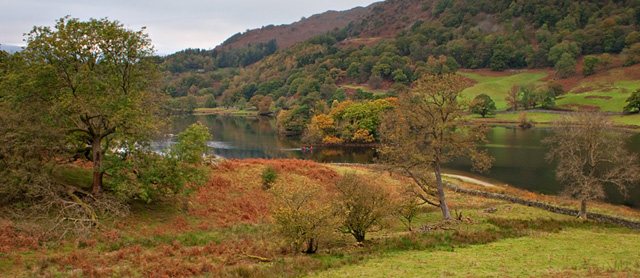
Rather than rushing to collect two shore photographs, compare the way each water sits within its surrounding slopes. Notice how the view changes when trees screen the water, when the path climbs slightly, and when the valley opens. The pleasure of the route comes from those changes in scale. A walk that includes plenty of pauses can be more memorable than a longer extension whose purpose is only to add distance.
This gives the day a clear place in a Grasmere stay. Pair it with a separate fell outing such as Helm Crag, or with a cultural walk on the Coffin Route, rather than trying to absorb all three into the same circuit. The two-lake walk is the water-and-woodland day: a planned return to Grasmere, enough variety to sustain a full outing, and no need to make summit height the measure of what you have experienced.
Questions answered
Can I use the Grasmere Trail’s one-way distance for this circuit?
No. The named trail connects Grasmere and Ambleside. A two-lake circuit from Grasmere has its own route line and distance definition.
Is a two-lake circuit the right choice for a short surfaced walk?
Not necessarily. It includes connections and changes of level. A specific shorter section should be assessed against the actual surface requirement rather than assuming the whole circuit matches it.
Sources & scope
Route facts are drawn from the resources below. The comparisons and recommendations are our research-based editorial analysis; this is not a claim of personal trail inspection. Access and conditions must be checked with the responsible land manager before travel.
- National Trust: walks around Grasmere and Rydal Water
- Lake District National Park: Grasmere Trail
- Lake District National Park: White Moss to Steps End
Editorial standards · Explore the destination guides
Found a detail that needs correcting? Send the guide URL and a supporting source so we can review the exact route version.