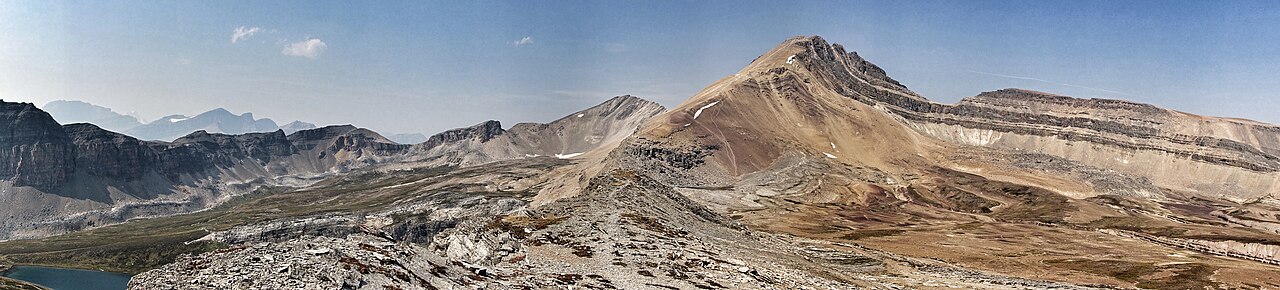

The meadow journey is the reason to choose Helen
Helen Lake is not the place to choose if you want a few minutes beside water during an already crowded drive. Its appeal is the progression from forest into open meadow and then the lake within the mountain setting. The approach is a substantial part of the experience. Choose it because that transition interests you, not merely because another blue-water photograph has appeared in a list of parkway stops.
The destination makes a complete day without an added summit. Nearby Cirque Peak or Dolomite Pass may appear in broader route accounts, but those names define additional objectives with their own demands. Keep Helen Lake as the endpoint if that is the outing you assessed. A path continuing beyond water does not mean the lake walk is unfinished.
Put the trailhead in a realistic geographic cluster
The start is on the Icefields Parkway in the Crowfoot Glacier viewpoint area north of Lake Louise. This makes Helen relevant to a southern parkway walking day, but not interchangeable with Parker Ridge much farther north. A first itinerary should distinguish those clusters before allocating hikes. Otherwise the map can become a single string of attractive names with too much road travel hidden between them.
Use Helen as the main walk in its cluster. A short independently assessed viewpoint stop may complement it, but another major hike should not be assumed to fit because the road connects both starts. Count the full approach, destination time, return and access journey. The lake's position within a scenic-driving corridor does not reduce the effort of reaching it on foot.
Forest to open ground changes the day
The initial forest and later open setting offer contrasting kinds of walking and observation. Beneath trees, smaller details and the rhythm of ascent dominate. In the meadow, the relationship between the lake, surrounding landforms and distant mountain views becomes more apparent. Give both phases room. If you expect continuous open scenery from the first steps, you may have chosen the route for an image that describes only its later portion.
Open ground also means you should not infer conditions from the sheltered beginning. The route's suitability needs a current official assessment for the whole outing. A pleasant trailhead morning or a summer calendar date cannot establish what the higher section is like. This guide makes no claim about a guaranteed snow-free period or a protected bad-weather alternative.
Helen, Parker or a lake-level stop?
Choose Helen if you enjoy the journey as much as the destination. Choose Parker if the ridge panorama is the specific attraction and its location fits the itinerary. Choose a modest lake-level or viewpoint plan when the travel day leaves less room. This is a recommendation about matching activities to time, not a hierarchy in which the longest walk is always best.
Swipe the table horizontally to compare every column.
| Choice | Main reward | Time-and-effort implication |
|---|---|---|
| Helen Lake | A forest-to-meadow progression ending at a lake | A principal walking day |
| Parker Ridge | A compact high-ridge glacier panorama | A different, more northern open-country outing |
| Bow Lake shore or viewpoint visit | A closer lake-level experience | The selected walking scope still needs definition |
| Peyto viewpoint | An elevated view of a distinctive lake | A separate viewpoint objective rather than a meadow journey |
Keep peaks and passes outside the lake plan
A visible peak can make a destination pause feel like the start of a second outing. Do not add Cirque Peak because another party continues or a map makes the upper route look close. Likewise, an onward line towards Dolomite Pass belongs to a larger journey. Those objectives require their own informed route assessment. This guide provides no scrambling instruction or high-pass extension.
The correct finish can simply be a pause at appropriate established ground near the lake followed by a return. That preserves time to enjoy the meadow rather than spending every available minute climbing higher. A clear endpoint is particularly valuable for mixed groups, where one person's enthusiasm for the next landmark can otherwise redefine everybody's day.
Wildflowers and wildlife are observations, not appointments
Meadow photographs often emphasise flowers or animals. These are possible natural experiences, not features guaranteed by a booked date. Choose the route for its broader landscape, and let actual seasonal conditions supply the detail. A meadow without the precise bloom shown online can still reveal its relationship with the mountain basin. A guide should not promise an encounter or an exact flowering week to make the walk sound valuable.
Keep to the path and appropriate stopping places. Do not enter vegetation for a camera angle or approach wildlife to improve the image. The interest of the meadow comes from being a real place with its own processes. Observing without rearranging your route around a closer encounter protects both that character and the clear walking plan.
A complete day rather than an accumulating route
For Helen Lake, Parks Canada lists 5.9 kilometres one way, with 530 metres of ascent and 90 metres of descent, and a four-to-five-hour return estimate. The retraced lake outing is 11.8 kilometres. That makes Helen a much larger walking allocation than Parker's 5.4-kilometre return, though the routes reward different landscapes and occupy different parts of the parkway. Choose Helen for the forest-to-meadow journey itself and keep the original lake endpoint. An added Cirque Peak or pass objective cannot inherit these figures. Give any roadside stops the time left around the selected main hike, rather than treating the full lake day as one more pullout.
For a first Banff visit, Helen adds a category distinct from town walks and the famous Louise-area shore scenes. It earns that place through the forest-to-alpine transition, not through a requirement to climb the adjacent peak. Choosing the lake as enough can produce a more coherent and memorable day than turning a well-understood hike into an unplanned mountain extension.
Questions answered
Is Helen Lake a short walk beside the Icefields Parkway?
No. It is a substantial approach through forest and meadow. Plan it as the principal walk rather than a brief roadside stop.
Do I need to continue to Cirque Peak?
No. Helen Lake is a complete endpoint. Peak or pass extensions are separate objectives requiring their own informed assessment.
Sources & scope
Route facts are drawn from the resources below. The comparisons and recommendations are our research-based editorial analysis; this is not a claim of personal trail inspection. Access and conditions must be checked with the responsible land manager before travel.
- Official tourism: Helen Lake forest-to-meadow character
- Parks Canada: Helen Lake location and route scope
Editorial standards · Explore the destination guides
Found a detail that needs correcting? Send the guide URL and a supporting source so we can review the exact route version.