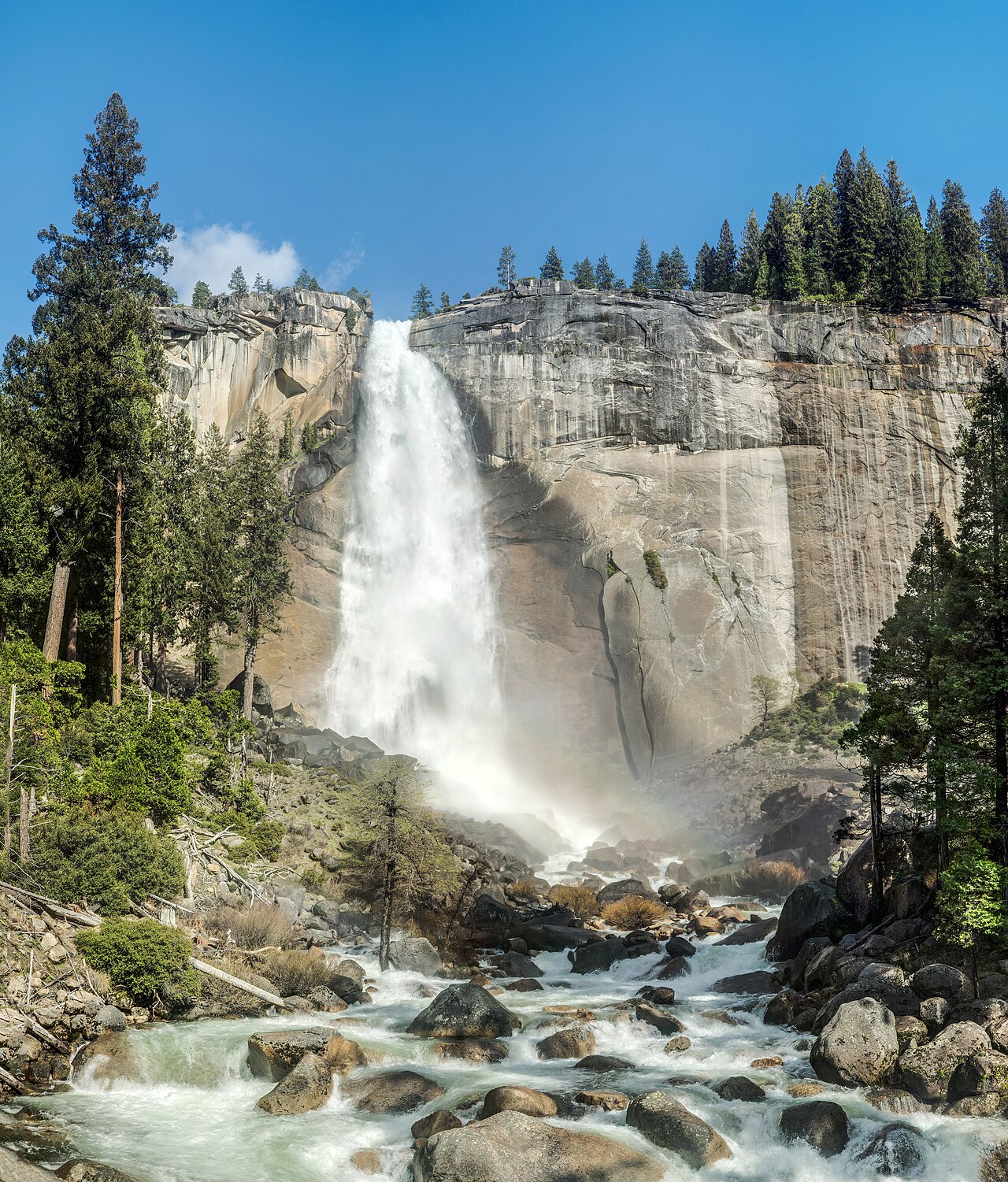

Nevada Fall is a complete uphill day
The attraction of the Nevada Fall outing is the way one waterfall landscape follows another as you gain height from Happy Isles. That progression can make the next stage look like a small addition to the last. In planning terms, it is better to reverse the perspective: choose Nevada Fall as the destination first, then assess the whole approach and return that reaching it requires. The footbridge and Vernal Fall are stages within that larger commitment, not evidence that the remaining outing will be minor.
This article concerns the established trail system toward Nevada Fall, without extending into Half Dome, Little Yosemite Valley backpacking routes, or informal river-edge detours. Keeping those boundaries clear makes the decision useful. A route can be impressive without being an invitation to continue beyond its planned endpoint. If your group wants to experience the full waterfall climb, allocate the day to it and preserve time for the descent instead of attaching another major hike afterward.
Read the climb as three decisions
Start at Happy Isles with the complete official route already understood. The Vernal Fall Footbridge is the first recognizable shorter objective. It lets a group choose a defined bridge-and-back outing instead of the upper trail. Beyond that, the route toward Vernal Fall introduces a steeper waterfall approach. Continuing toward Nevada Fall adds a further stage, so the upper destination should remain a deliberate commitment rather than the result of following the stream of people ahead.
For a group choosing the full outing, these stages provide places to compare progress with the plan. They do not remove the need to decide scope beforehand. Agree that stopping at a shorter objective is an acceptable outcome if the day does not match expectations. The useful question is whether the complete return remains comfortable, not whether the next waterfall is close enough to justify one more push. A destination is never the halfway point in effort simply because it appears halfway down a list.
Resolve the descent before you climb
At the top of Nevada Fall, the bridge over the Merced connects the waterfall side with the John Muir Trail return. Retracing the Mist Trail returns through the steep waterfall stairway; the John Muir alternative takes a longer graded line with views of Liberty Cap and Nevada Fall before rejoining the lower approach. The latter exchanges extra walking for a different descent surface; it does not remove the day’s substantial height loss. Choose it when avoiding a second passage down the Mist stairway is worth the longer return, provided that entire alternative is open and appropriate. Decide this before climbing, since neither trail name alone describes the full circuit.
Official directions and restrictions govern which options are available on your date. This guide does not supply a seasonal promise about a particular section. Its recommendation is to carry one primary plan and a clearly understood response if that plan is unavailable. If the return depends on a connection you have not checked, the full hike is not ready. A famous trail name is not enough information to improvise a late-day descent through several junctions.
What the waterfall setting adds to the difficulty
The upper Mist Trail is known for steep steps and proximity to waterfall spray. Those features can change both pace and comfort compared with an ordinary graded forest path. Think about the least confident person's response to that environment, not just the strongest walker's ability to climb. A group can be comfortable with long distances yet dislike closely spaced steps or a wet approach. Those are legitimate route preferences, not obstacles to be dismissed once everybody has arrived.
The photo at the top does not show all the attention required along the way. Build pauses where they fit the established trail and avoid using narrow passages as gathering places. Near a waterfall, stay within the designated walking and viewing areas. This is not a guide to entering the river, seeking an unofficial ledge, or finding a shortcut between trail lines. The legitimate route already supplies enough landscape variety to make a substantial day.
Compare the alternatives by what they solve
If your primary goal is a shorter introduction to the Happy Isles river corridor, choose the Vernal Fall Footbridge return. If the goal is the higher waterfall scenery with a substantial climb, the complete Nevada Fall outing may fit, provided its demands match the group. If the goal is a broad valley panorama without a waterfall approach, compare an entirely different route rather than forcing the Mist Trail to serve every kind of Yosemite ambition.
Upper Yosemite Fall and Four Mile Trail are relevant comparisons for a strong walking group, but each has its own terrain and return problem. The choice is not a ranking of which famous name is best. Nevada Fall emphasizes a sequence of river and waterfall landscapes. Four Mile Trail emphasizes a sustained ascent toward Glacier Point. The Upper Yosemite Fall route works up the north side of the valley. Pick the landscape you want to spend a whole walking day experiencing.
Do not turn the day into a trail collection
Keep other substantial trails off the schedule. A second major ascent would compete with the time and energy needed for the descent from Nevada Fall, while a fixed evening commitment can encourage rushing exactly when the group wants to slow down. A successful day may contain only one named hike. That leaves space for looking back along the route, eating without hurry, and making decisions based on the actual progress rather than on the pressure of an ambitious list.
For mixed abilities, a split-group plan needs more than different turnaround points. Each group must have suitable preparation, a complete return, and realistic meeting arrangements. Do not leave one person with an unclear route or require a slower group to wait at an exposed destination for an unpredictable time. Often the cleaner choice is a shared shorter outing, with the full Nevada Fall day reserved for people who independently want and understand it.
The evidence to carry into your final decision
Use the NPS dedicated Vernal and Nevada Falls page for the route variants and official map, then consult current park guidance close to the outing. Write the start, endpoint, return line, and main decision points in your notes. Avoid mixing a distance for one variant with a map of another. The full hike earns its place when the entire route is appealing and manageable, not merely because Nevada Fall is a photograph you would like to bring home.
Questions answered
Is Nevada Fall a small extension beyond Vernal Fall?
Treat it as a complete destination requiring assessment of the whole climb and descent. Passing a lower waterfall does not establish that the remaining outing is minor.
Can we choose the descent once we reach the top?
Research the return and permitted route options before departure. Current official directions determine which lines are available.
Should this be combined with another major Yosemite hike?
Make it the main walking commitment of the day. Preserving time for the descent and decisions is more useful than adding another strenuous objective.
Sources & scope
Route facts are drawn from the resources below. The comparisons and recommendations are our research-based editorial analysis; this is not a claim of personal trail inspection. Access and conditions must be checked with the responsible land manager before travel.
Editorial standards · Explore the destination guides
Found a detail that needs correcting? Send the guide URL and a supporting source so we can review the exact route version.