
Start by choosing the complete journey
Walla Crag rises above the eastern side of Derwentwater. From Keswick, it can be approached as a town-to-fell walk, but published routes often begin elsewhere. The National Trust’s detailed circuit starts at Great Wood and continues via Ashness Bridge. That is useful evidence about the landscape and path connections; it is not a distance for every route beginning in Keswick. Decide where your day actually starts before selecting a route total.
A town-based outing can favour a direct approach toward the Rakefoot side and a return using familiar connections. A larger circuit can include Ashness and the lower eastern-shore landscape. Both reach the same upper viewpoint, but they use the rest of the day differently. The choice is not simply clockwise or anticlockwise. It is whether you want the fell to be the principal destination or one component in a longer sequence of woodland, open ground and lake views.
Two plans that should not share one distance
For a compact Keswick outing, use Springs Road and Springs Wood as the named approach references, connect toward Rakefoot and make Walla Crag the high objective before returning on the researched town-side route. This is the stronger choice for an arrival day or for walkers chiefly seeking the lake panorama. It does not need Ashness Bridge to become complete.
For the landscape circuit, use the National Trust’s Great Wood start and its Walla Crag–Ashness–lower return sequence. Choose this version when the packhorse bridge and changing woodland are part of the desired day. If starting on foot in Keswick, add both town connections to that Great Wood circuit. The practical distinction is therefore a town-to-viewpoint return versus a longer fell-and-bridge circuit, not simply two directions around an identical loop.
The ascent is a transition through landscapes
The Rakefoot side connects enclosed lanes and woodland with the more open upper fell. This changing character is one reason Walla Crag is an attractive counterpart to a lakeshore day. Instead of following the water continuously, you gain height and see the lake as part of a wider valley. Ground that begins relatively enclosed can become stonier and more exposed as the ascent progresses.
Do not assume that a low fell above town behaves like a landscaped urban viewpoint. The National Trust identifies wet and rocky ground within its route account. Those descriptions apply to actual path sections rather than to the view in the photographs. When discussing the walk with companions, describe that transition explicitly: a town connection, a climbing approach, then open fell walking. It gives a more accurate expectation than calling the whole outing a short walk from Keswick.
The viewpoint is an endpoint worth defining
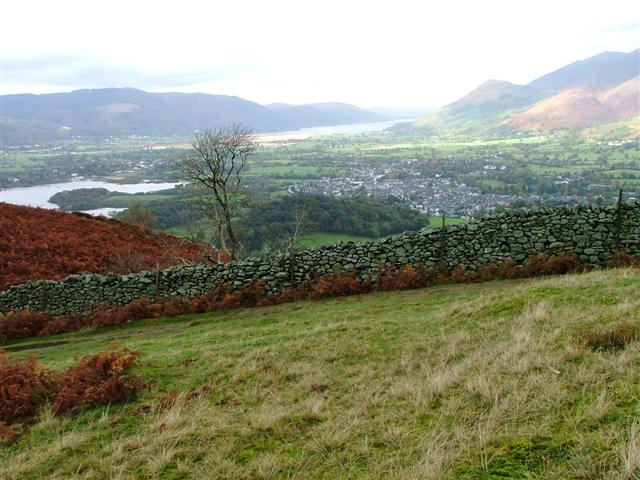
At the upper viewpoint, Derwentwater’s islands and the alignment of the surrounding slopes become easier to understand. Cat Bells occupies the opposite side of the water, while the landscape opens toward the northern basin. This is a different perspective from the foreshore at Keswick: height makes the lake’s shape legible rather than simply bringing its edge closer.
Treat that view as the main goal if you have chosen a compact fell day. There is no requirement to continue south merely because the path and scenery remain inviting. A direct return can leave enough time to notice how the woodland approach looks in the opposite direction. If you have chosen the Ashness circuit, however, remember that the summit is not the halfway point of every possible version. The remaining path, descent and town connection must already be part of the plan.
What Ashness adds
Continuing toward Ashness introduces a different feature rather than another summit. The upper walking leads toward the packhorse-bridge landscape and then connects with lower paths back toward Great Wood. This produces variety, but it also adds route choices after the main fell view. The bridge should not be included casually as though it sits immediately below the summit beside the finish.
The National Trust’s circuit uses a lower return toward Great Wood rather than simply staying on the road all the way down to the lake. That distinction matters when translating an account into your own route card. Read the whole mapped circuit and understand the finish. If starting in Keswick, complete the connection back to town deliberately. Arriving at Great Wood completes the Trust’s defined circuit, but it does not complete a walking day that began at your accommodation in Keswick.
When the direct version is the stronger choice
Choose the more compact town-to-viewpoint outing if the climb is the experience you want, if your group prefers a simpler return, or if the day already contains travel. Choose the Ashness extension when landscape variety is a clear priority and the longer return suits the party. This is not a judgement that one route is more authentic. It is a way of matching the rest of the day to the objective that brought you to Walla Crag.
A common planning error is to collect attractive fragments from several guides: one start near town, a summit photograph, an Ashness extension and a short distance measured from Great Wood. The resulting route exists only as an incomplete collage. Avoid that by writing the named sequence from start to finish before leaving. Once the sequence is coherent, Walla Crag becomes an excellent way to contrast a fell perspective with the low shore paths around Derwentwater, without needing to add every nearby viewpoint to the same day.
For the town-based version, Springs Road and Springs Wood give useful named references in Keswick tourism’s own account before the route reaches the higher Rakefoot connection. Retaining those names makes the approach more concrete than treating the whole eastern side of town as one undifferentiated trailhead.
Questions answered
Can I use the Great Wood circuit mileage for a Keswick start?
Only if you also account for every connection between Keswick and that circuit. The published start is part of the distance definition, so moving it changes the complete journey.
Is Ashness Bridge essential to a Walla Crag walk?
No. It adds a different landscape and a longer return. A direct viewpoint-focused outing is a complete route choice when its approach and return are planned.
Sources & scope
Route facts are drawn from the resources below. The comparisons and recommendations are our research-based editorial analysis; this is not a claim of personal trail inspection. Access and conditions must be checked with the responsible land manager before travel.
- National Trust: Walla Crag to Ashness Bridge
- National Trust: Derwentwater and Keswick
- Lake District National Park: Derwentwater and Keswick
Editorial standards · Explore the destination guides
Found a detail that needs correcting? Send the guide URL and a supporting source so we can review the exact route version.