
A compact circuit with two different levels
Rannerdale Knotts rises between the Buttermere and Crummock landscapes. The National Trust’s route begins in Buttermere, climbs onto the ridge and returns through lower ground toward Crummock Water and the village. That gives the outing a clear high-and-low structure. Its published length is around 4.8 kilometres, but the attraction is the change in viewpoint rather than the smallness of the number.
Do not confuse this route with a stroll into the Rannerdale valley to look at seasonal flowers. The ridge circuit has an ascent and an upper walking section. A photograph of a bluebell-covered valley floor does not describe that terrain. Choose the circuit because the ridge and the lower return both appeal, and keep flower expectations separate from the durable geography of the route. The landscape remains worth understanding without a promise about any particular season’s display.
The Buttermere start frames the ascent
Beginning in the village makes the route a self-contained outing from the northern end of the lake area. The initial connections lead toward the higher ground rather than circling Buttermere’s shore. This is a useful distinction when comparing routes from the same start: a shared village does not imply a shared walking experience or distance.
A party choosing the ridge should expect the climb to be a central part of the day. The summit view is earned through that ascent, not reached by a nearly level track from the village. The National Trust describes the route as fairly strenuous despite its moderate overall category. Retain the actual terrain explanation rather than using the category alone. It helps identify whether the group wants a compact fell outing or a lower water-focused walk.
The ridge gives the lakes their relationship
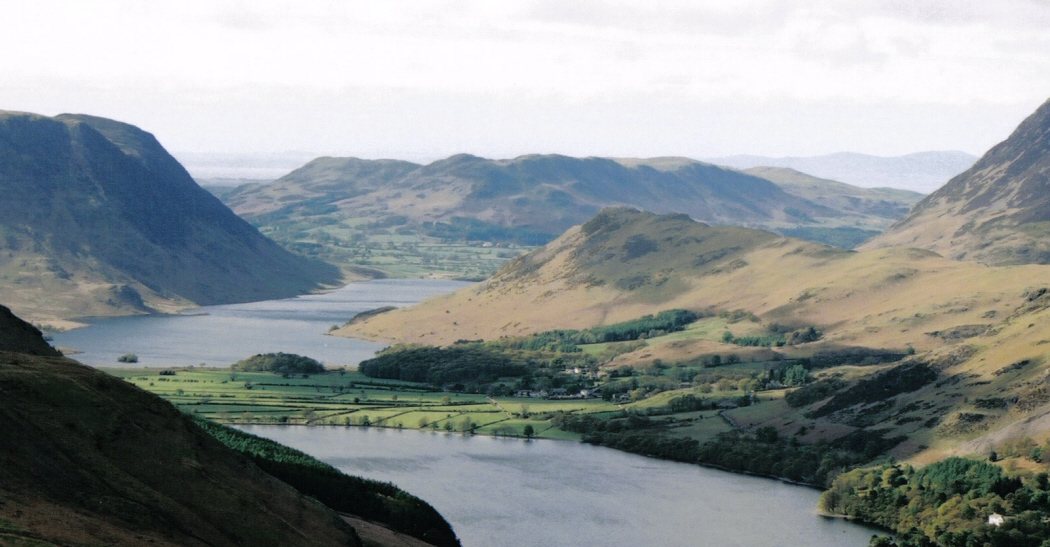
From higher ground, the surrounding waters can be understood as parts of a connected valley landscape. The point is not merely to see more distant mountains than from the shore. The ridge changes the scale of familiar features: a lakeside bend becomes part of a basin, and the village becomes one place within a wider arrangement of water and slopes.
This is a good reason to avoid rushing straight through the upper section. A modest ridge can provide a useful panorama without becoming a long mountain traverse. Stay with the intended Rannerdale objective rather than allowing every visible continuation to suggest another summit. A route selected for its bounded scale works best when its high point remains the planned goal and the lower return remains part of the experience, not an afterthought once a photograph has been taken.
Crummock gives the return a different character
The published circuit descends toward the Crummock side before returning through the lower wooded landscape toward Buttermere. This is the element that distinguishes a circular day from reversing the ridge ascent. It offers a closer relationship with water and vegetation after the upper outlook. The return is therefore a second perspective on the place, not simply the quickest way to leave it.
It still belongs in the route assessment. A lower path can have uneven surfaces and connecting rises; lower does not mean a seamless promenade. Read the full mapped line and its terrain notes before selecting the circuit for somebody who has a specific surface requirement. The benefit of the loop is variety, while the cost is the commitment to complete its different sections. That trade-off is more useful to understand than a generic statement that the circuit is suitable for everyone who walks regularly.
Keeping the ridge and Crummock return together also avoids confusing Rannerdale Knotts with the separate higher objectives around the same valley. The named circuit is already a complete landscape journey from Buttermere.
Choose between ridge and lake honestly
The Buttermere lake circuit emphasises shore scenery, while Rannerdale Knotts gives an elevated ridge experience with a lower return. They are alternatives for different days, not necessarily ingredients to combine. A visitor who wants water-level views and no deliberate summit goal may prefer the lake circuit after checking its own rocky interruption. A walker wanting a compact climb and a panorama may prefer Rannerdale.
Do not select the ridge simply because it looks shorter on a list. The climb and terrain can make it feel more demanding than a longer low-level outing. Equally, do not select the lake circuit assuming that low-level means uniformly smooth. Comparing the actual demands produces a better choice than ranking by distance. For a stay around Buttermere, giving one day to the ridge and another to the water can provide a stronger contrast than assembling both into an overfilled single itinerary.
A ridge-focused day and a shore-focused day also produce different stopping patterns. The former invites pauses to connect distant features across the basin; the latter invites closer attention to trees and water. That distinction can help a group choose even when both routes are within its physical range.
Questions answered
Is Rannerdale Knotts the same as a valley flower walk?
No. The ridge circuit climbs to higher ground and returns by a different lower line. Seasonal flower viewing is a separate interest and should not define the route’s terrain or promise.
Can I add the Buttermere circuit afterwards?
Only as a separately calculated longer day. Both are complete outings, and combining them changes the distance and accumulated effort.
Sources & scope
Route facts are drawn from the resources below. The comparisons and recommendations are our research-based editorial analysis; this is not a claim of personal trail inspection. Access and conditions must be checked with the responsible land manager before travel.
- National Trust: Buttermere to Rannerdale walk
- National Trust: Buttermere Valley
- National Trust: valley walking alternatives
Editorial standards · Explore the destination guides
Found a detail that needs correcting? Send the guide URL and a supporting source so we can review the exact route version.